


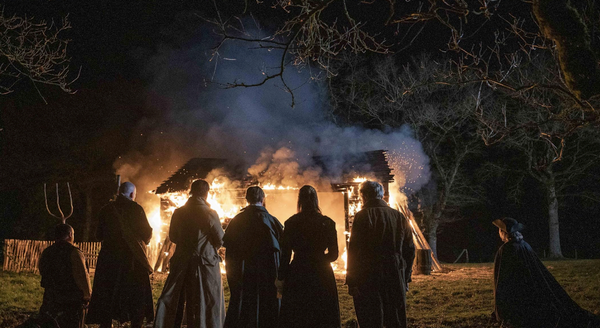
Following the persecution of the Catholic Church, the execution of King Louis XVI, and the introduction of mass conscription, Catholic royalist peasants in the Vendée region of western France revolted against the republican regime in 1793. At first, the rebellion was successful. Yet the government eventually put it down through scorched-earth tactics, resulting in a death toll of over 200,000, perhaps one third of the population of the region. Because this episode captures the Revolution’s brutality while also putting the counter-revolution on the side of the people, it has remained integral to the self-understanding of the French right. But it remains largely unknown outside of France.
Victory or Death, a 2023 French film newly released in the United States, strives to change that. It follows the career of General François-Athanase Charette de La Contrie (played by Hugo Becker, known to some American viewers for his role in Gossip Girl). A veteran of the American War of Independence, Charette is called out of retirement in 1793 to save the Vendéens from the Republic’s bayonets. The film follows his exploits, until his forces are overwhelmed by the revolutionary armies and he is executed. It is a story of heroism that ends in martyrdom. Like Joan of Arc, Charette is denied the sacraments by his captors.
Victory or Death is a vivid and thrilling entertainment, but it has a serious purpose. Produced by figures associated with the French right and the historical theme park Puy de Fou, it seeks to promote knowledge about an episode of repression that Alexandr Solzhenitsyn regarded as a dress rehearsal for later left-wing totalitarianism. Battles over historical memory—whether over the French Revolution, the Spanish Civil War, or the Russian Revolution—are becoming more important. The younger strands of the contemporary left see their struggles in terms of older, European ones. They identify rising fascism as one of their top concerns. They think America is controlled by fascists, and they draw the logical conclusion.
Victory or Death seeks to promote a rightwing alternative to this understanding of history—appealing to the same audience that attends Puy de Fou. Created by the Catholic entrepreneur, writer, and politician Philippe de Villiers, Puy de Fou uses the format of the theme park to tell the history of France through a series of large performances based around massive sets. To this end, the park contains several medieval villages and castles, one of the largest falconries in the world, and a reconstruction of a Roman gladiatorial amphitheater that seats 7,000 people. Performances are technically impressive, choreographed spectacles involving acrobatics and live animal acts, with battles and dances centered around heroic, romantic protagonists.
“Puy de Fou’s shows are about as historically accurate as a Buffalo Bill’s Wild West show.”
Puy de Fou’s shows are about as historically accurate as a Buffalo Bill’s Wild West show. The gladiatorial games blend the aesthetics of Ben Hur’s chariot race scene and Ridley Scott’s Gladiator (the amphitheater was opened shortly after the second film’s release). When English armies besiege a French castle in one show, they are defeated by manifest acts of divine intervention.
Now over forty years old, Puy de Fou is a commercial and cultural success. It’s run on regional patriotism, mustering an army of young volunteers who spend their summer keeping the park going. It is far more affordable for a family to visit Puy de Fou for three days than it is to visit Disneyland for one. The park has been steadily growing since its launch and has won numerous international prizes for the quality of its shows. Despite its distance from Paris, Puy de Fou now receives 2 million visitors a year, making it the third largest theme park in France. De Villier has shared his understanding of French history with millions.
Right-of-center presidents of France since Giscard d’Estaing, including Emmanuel Macron, have visited Puy de Fou as a gesture of good will toward the right; Macron even exempted the park from some Covid restrictions. But Puy de Fou has never been able to translate its unique cultural success into right-wing politics. De Villiers ran for president twice and failed. When Éric Zemmour made his unsuccessful presidential run in 2022, with de Villiers’s endorsement, he borrowed the music from the falconry show as his own campaign theme.
The Puy de Fou model is in the process of being exported abroad. Puy de Fou España opened in 2021; its spectacles tell the history and legends of Spain. There are now plans to open a Puy de Fou in Oxfordshire. Victory or Death, Puy de Fou’s foray into film, is part of this expansion. Like Pirates of the Caribbean, Victory or Death is based on a theme park ride, but that is where the comparisons end.
“The Puy de Fou model is in the process of being exported abroad.”
Le Dernier Panache, the show that covers General Charette and the Vendée uprising, was launched in the 2010s. It ensures the audience remains entertained, but it transcends Disneyland’s frivolity. Disney’s “Pirates of the Caribbean” ride adapts an old feature of American amusement parks, the “dark ride.” It takes visitors on guided boats through caves to immerse guests in pirate tropes. Le Dernier Panache uses state-of-the-art technology to tell a serious story. The show takes place in a theatre that seats 2,400 at a time. The theatre rotates to face different stages where hundreds of live actors re-enact different episodes in the life of General Charette and the Vendée uprising. The stages mix palaces, battlefields, and reconstructed cross sections of warships from the age of sail, all enhanced with IMAX-style cinematic projections and an epic soundtrack.
The cultural success of Puy de Fou is the one thing—perhaps the only thing—the French right has done well in the past forty years. There is nothing like it in America. Disney functions as a Mecca of American popular culture; you have a good experience because everything about it is familiar. You go there to meet the characters you have heard about and watched all your life. But Disney’s feedback loop has ensured that Mickey Mouse has become a more recognizable American cultural icon than Paul Revere. Disney’s frivolous mass culture has no place for the canon of American greatness. As a result, the cultural canon drifts toward an infantilizing, even obsessive fandom that also succumbs to the pull of progressivism.
Puy de Fou is likewise premised on the realities of mass culture. But its shows introduce you to the unfamiliar, to characters that you probably don’t know. It has only a few minutes to entice you through entertainment to appreciate their greatness. When the theme park works, its feedback loop memorializes the names of neglected national heroes.
In 1974, just after Disneyworld launched Pirates of the Caribbean and just before Puy de Fou’s first show, the French translation of Solzhenitsyn’s oral history of totalitarianism, The Gulag Archipelago, was released. It went on to sell 1.2 million copies, shifting public opinion on communism and the USSR. Such an event depended on a healthy literary culture. It would be impossible to repeat that today.
We can pine for more high art or a return to a reading public, but that’s not the world we live in. Disney and Puy de Fou thrive became their architects understand our post-literary environment. Successful storytellers are not those who rely on print, but those who best master the techniques of orality to entertain. The question is whether we amuse ourselves to death, or whether our amusements can serve a nobler purpose. This hinges upon what kinds of stories we tell. Victory or Death shows that the Disneyfication of mass culture need not be the last word.